









Here's an uncomfortable exercise. Open Seller Central, go to Reports, then Business Reports, then Detail Page Sales and Traffic. Look at the column called Unit Session Percentage. That's your Amazon conversion rate, and for a lot of brands reading this it will be sitting somewhere painful.
If 100 people visit your listing and 8 buy, the other 92 looked at your product and chose not to have it. Most brands respond to that number by buying more traffic. Which means paying to send 92 more people away.
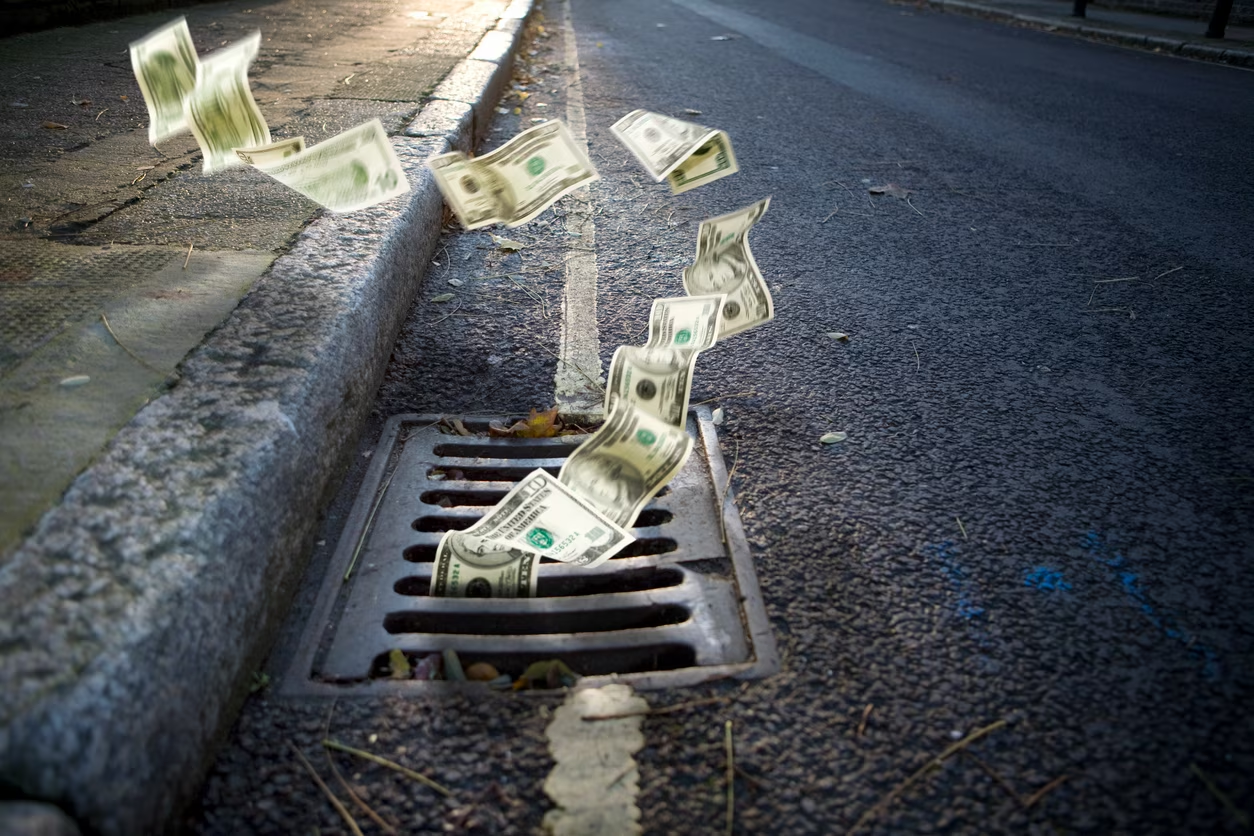
The traffic was never the problem. The listing leaks. And in our experience the leak is almost always one of five holes, usually two or three of them at once.
Hole one: a main image that loses the click
Conversion starts before anyone reaches your page. Your main image is competing in a search grid against a dozen others at thumbnail size, and if a shopper can't tell what your product is or why it's the better one in half a second, your click-through rate dies quietly. You never see those lost sales in any report. They just never arrive.
Look at your listing in actual search results, on a phone, next to your competitors. Not in isolation. A main image that looks fine on its own and invisible in the grid is invisible, full stop.
Hole two: nothing on the page says why you
We took on a consumer brand whose certified product was genuinely better than everything near it, and it was losing to cheaper uncertified rivals. The listing never explained the certification, so to the shopper it was the same product at a higher price. Once the listing led with the proof, sales rose 88% in under 12 weeks.
Bullets that list features without answering "why this one" convert nobody. A shopper on Amazon is always comparing. If your page doesn't make the comparison for them, they'll make it on price, and on price you probably lose.
Hole three: you're ranking for searches you can't win
Keyword mismatch is the quiet one. Your listing is indexed for terms that bring the wrong shopper, or your ads are bidding on them. Someone searching for a budget version of your category lands on your premium product, winces at the price and leaves. That visit torpedoes your conversion rate and teaches you nothing except, apparently, that you need more traffic.
Pull your search term report and look at what people actually typed before they clicked. If the intent behind those terms doesn't match the product on the page, no image or copy change will save the conversion. That one gets fixed in the targeting.
Hole four: the review deficit
Shoppers use reviews as a proxy for risk. Fewer reviews than the products beside you, a lower star rating or a recent one-star sitting at the top all raise the perceived risk of choosing you, and risk kills conversion at the exact moment of decision.
Before you despair at your rating, check whether it's even accurate. Broken variations and duplicate listings scatter reviews across pages so no single listing shows your real social proof. We've seen a rating move from 4.2 to 4.5 with zero product changes, purely from merging a broken catalogue correctly. If that sounds familiar, your review problem is usually a catalogue problem, and we've written that story up in full.
Hole five: price incoherence
This is the one nobody audits because it doesn't look like a listing problem. Your listing says premium. Your photos say premium. And the buy box says £11.99 because three sellers you've never heard of are undercutting each other on your product.
Shoppers notice incoherence even when they can't articulate it. A premium page with a collapsing price reads as either a scam or a clearance, and neither converts well at full margin. Worse, you don't control the price those sellers set, so every branding pound you spend props up their race to the bottom. Most brands think their Amazon problem is a marketing problem, and this is the clearest case of it being a control problem instead. If your price keeps sliding, start with why your Amazon price keeps falling rather than another round of copy tweaks.
Where your Amazon conversion rate actually leaks
Ads are water and your listing is the bucket. Pour water into a bucket full of holes and it just leaks. So before you spend another pound on the tap, check the bucket. Honestly, on your phone, as a stranger:
- Does the main image win the click in the search grid at thumbnail size?
- Does anything above the fold say why you, not just what you are?
- Do your search terms match the shopper your product is actually for?
- Do your reviews reflect the product, and are they all on one listing?
- Does the price on the buy box match the story the page tells, and do you control it?
Most listings we audit fail at least two, and the brands running ads on top of those failures are paying full price to run the demonstration over and over. Spotting a hole takes twenty minutes. Working out which one is actually costing you the sale, and fixing it without breaking something else, is a different sort of job.
None of this is glamorous work. Images, copy, catalogue hygiene, seller control. But it's the difference between a conversion rate that compounds every marketing pound and one that quietly taxes it.
If you've run those five questions and still can't tell which hole is draining yours, the diagnosis is free. Worst case, you find out the bucket holds water.



.png)
.png)
.svg)