








Ask ten people how to launch a product on Amazon and you'll get ten versions of the same answer. Run ads hard, get reviews fast, price low to start. It's not wrong exactly. It's just not where launches are won.
Launches are won before day one. By the time you press publish, the important decisions have mostly been made, and if they've been made badly, the ads and the reviews and the launch price are just ways of finding out faster.
We've launched products that hit #8 in their category inside 30 days and we've inherited launches that never recovered. The difference was almost never effort on launch day. It was the boring work in the weeks before.
Here's what actually decides it.
Pick the category like it matters, because it does
Amazon ranks you against the products in your node, and Best Seller badges are awarded within it. Choose a category that's slightly wrong and you're either invisible in a giant and competitive node or winning a badge nobody searches in.
Most brands accept whatever node the setup flow suggests and never think about it again. The better question is where the products you'll genuinely compete with sit, not where you'd like to sit, and whether there's a realistic route to the top of that node within a few months. Answering that honestly is a piece of competitive analysis, not a dropdown decision.
A certified product we launched went to #8 in its category within 30 days. That number was only possible because the category was chosen deliberately, against real competitors, with a realistic route to the top of it.
Get this wrong and everything downstream gets harder. It's also a pain to change later.
Do the keyword work before the product is final, not after
Most brands write the listing, then look for keywords to sprinkle into it. Backwards. The search data should shape the listing, and ideally the product itself.
Done well, the research reads like a brief. It tells you which claims to lead with, which use cases to photograph and which terms your title has to carry. Getting there takes more than a keyword tool and an afternoon, which is why so few listings are built this way.
We once built an entire product from this data, working out what people were searching for and failing to find before a unit existed. It converted at 25% from launch. That's an extreme version of the principle, but the principle holds for every launch: the demand is already written down in the search bar. Read it first.
Images are the product
On Amazon the customer can't pick your product up. Your main image is the shelf, the packaging and the first impression all at once, compressed into a thumbnail competing with forty others.
Before launch you want the main image tested against the competition it will actually sit beside in results. Then secondary images that answer the questions a shop assistant would: how big is it, what's in the box, how do I use it, why is it better than the cheaper one two rows down.
If the honest answer is "we've got the shots from the brochure", you're not ready. Brochure photography sells to retail buyers. It does not sell to someone scrolling on their phone at 10pm.
We don't sign off a launch until the thumbnail has survived that grid on a phone screen. Most fail the first time round. The listing is a shop the customer can't walk into, and the main image is the window.
Have a reviews plan that doesn't get you suspended
Every launch needs early reviews and there are only a few legitimate routes to them. Amazon Vine is the main one, and the timing of it matters as much as the enrolment, because reviews take weeks to land and a launch wants social proof on the page before the first real sales push, not after. Sequencing that against the stock arriving and the ads switching on is half the job.
What you don't do is buy them or rebate them or ask your mates. Amazon is better at spotting this than people think, and a suspension during launch is the one setback you can't spend your way out of.
Stock depth is a ranking decision
Going out of stock during launch doesn't pause your momentum, it resets it. Rank decays, ads switch off and when you come back in stock you're relaunching, except now the honeymoon period is spent.
So the real stock question is depth against your target run rate, measured in months rather than weeks, with an honest view of how fast you can replenish. If the answer means launching a month later with proper depth, launch a month later. A delayed launch recovers. A stockout at week three often doesn't.
Build the ad structure before you need it
Launch advertising is less about spending big and more about spending in a structure you can read. The campaigns should be built so that within days you can tell which pool of demand is converting and which is burning budget. Most launch accounts we inherit are built so nobody could ever tell.
That certified product held its ROAS above 4 through launch. Not because the bids were clever, but because the listing had already been built to convert and the campaigns were structured so we could see what was working within days rather than months. Sales were up close to 90% in under twelve weeks. The ads amplified a listing that deserved it.
If you want the fuller argument on why the first month carries so much weight, we've written about that separately in your first 30 days on Amazon.
The part nobody puts on the checklist: who else is selling it
This one catches good brands out. You can do all of the above perfectly and still watch the launch unravel because three resellers appeared on the listing in week two, undercut your price and took the buy box you were advertising for.
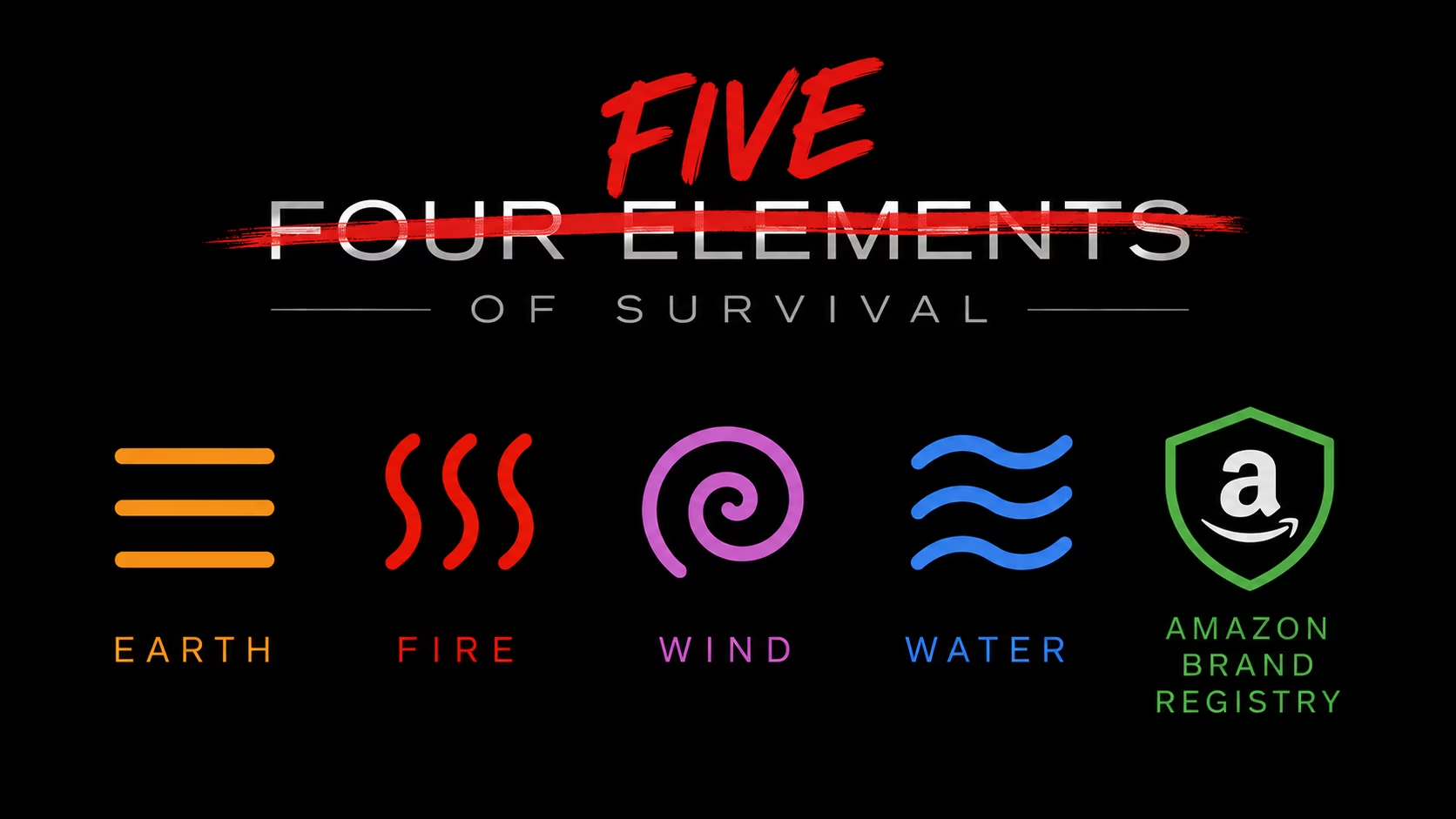
Every pound you spend on ads drives traffic to whoever holds the buy box. If that's not you, you're funding someone else's launch. Before day one, know exactly who is authorised to sell this product, have Brand Registry in place and have a plan for the sellers you didn't invite. We've covered why prices slide when you don't, and it applies double during a launch, when your price perception is being set for the first time.
Most brands file this under "legal, for later". Wrong drawer. This belongs on the launch checklist, arguably at the top of it, because it's the one item no amount of marketing budget can fix.
What launching on Amazon looks like when the groundwork is done
Honestly? Quiet. The listing goes live complete, with A+ content, full imagery and Vine already working. Ads switch on into a structure that was built weeks ago. Stock is deep. You spend the week reading search term data and watching conversion, not firefighting.
Compare that with the common version: listing goes live half-finished, images "coming next week", ads thrown at broad match to see what sticks, first stockout at day 20. Then the conclusion that "Amazon didn't work for us".
The product was rarely the problem in those stories. The preparation was.
If you're planning a launch and some of this list is making you uncomfortable, that's the useful kind of uncomfortable. It's all fixable before day one and expensive to fix after it. We run launches like this for the brands we work with, groundwork first, and we'll happily tell you what's missing from yours while it still costs nothing to fix.



.png)
.png)

.svg)